
California Contractor Deposit: How Much Before Work Starts?
A California contractor wants half up front to order equipment. How your price, their license page and your signing date change what's legal.
The short version: Before work starts, a California contractor can ask for or take no more than $1,000 or 10% of the contract price, whichever is less. On a $14,000 AC and furnace replacement that’s $1,000, not half, and needing to order the equipment doesn’t change it. The equipment gets paid for once it’s delivered to your home.
Why it matters: Your contract price sets the number (under $10,000 it’s the 10%). The one exception is a contractor whose CSLB license page shows a blanket performance and payment bond. And if you signed at home in the last 3 business days, or 5 if you’re 65 or older, you can still cancel in writing and get your money back within 10 days.
Say the contract for a new AC and furnace was signed at the kitchen table on a Monday evening, $14,000 in total, and the salesperson left with a $7,000 check “to order the equipment.” By Wednesday the check has cleared. For what comes later in this post, Monday is the date that counts, not Wednesday.
California makes every home improvement contract carry a “Down Payment” heading with the amount written in, and, in bold type of at least 12 points, the sentence “THE DOWN PAYMENT MAY NOT EXCEED $1,000 OR 10 PERCENT OF THE CONTRACT PRICE, WHICHEVER IS LESS.” On this contract the first says $7,000 and the second says it can’t.
Before work startsWhat the Down Payment Line Is Allowed to Ask For
CSLB’s consumer guide to home improvement contracts and Business and Professions Code section 7159.5 say the same thing. The down payment can’t be more than $1,000 or 10 percent of the contract price, whichever is less, and finance charges don’t count toward the price. The contractor may neither ask for more nor accept it.
Ten percent of $10,000 is $1,000, so on every contract above $10,000 the ceiling is $1,000, unless the license page shows the blanket bond covered further down. Below $10,000 the 10% is the smaller figure. On the $14,000 job the legal down payment is $1,000 and the $7,000 check is $6,000 over it. A $6,000 roof repair has a $600 limit, so a flat $1,000 deposit there is already $400 too much.
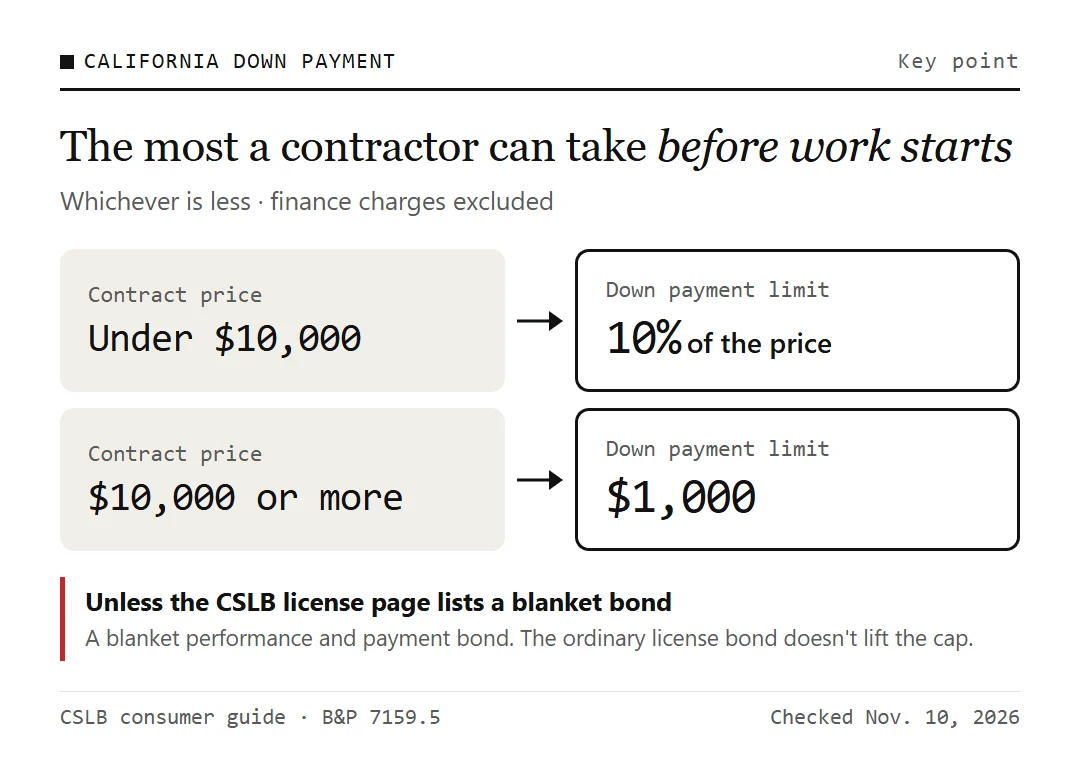
Find your contract price, then the row it falls in.
The number that surprised me in the $14,000 example was how early the percentage stops mattering. Once the price passes $10,000 the cap never moves again, so a $14,000 furnace swap and a $60,000 remodel get the same $1,000.
The reason written on the contract isn’t an exception either. CSLB’s guide puts it in one line: “There are no exceptions for special order materials.”
The calculator takes your contract price and the amount asked for or already paid. The gap it shows is how far over the line the request sits, which isn’t the same thing as a refund amount.
What your California contractor can take before work starts
Use the contract price without finance charges. The blanket bond, if there is one, is listed on the contractor's license detail page on CSLB's site.
If your result doesn't match your bill or notice, check the exact figure on CSLB's home improvement contracts guide. Rules as of 2026-11-10
Show the breakdown and basis
—
Legal down payment = the lesser of $1,000 or 10% of the contract price, finance charges excluded. Over the limit = the amount asked for or paid minus that figure. A CSLB-approved blanket performance and payment bond on the license page removes the cap. Signed at home: 3 business days to cancel in writing, 5 if the buyer is 65 or older.
Values are calculated in your browser and are not saved or sent anywhere.
Checked against CSLB’s consumer guide (October 2024 edition) and CSLB Industry Bulletin #22-14 on Nov. 10, 2026.
After the down paymentWhen the Equipment Can Go on the Bill
After the down payment, the contractor can’t ask for or accept a payment worth more than the work performed or the material delivered. The contract has to list each payment under the heading “Schedule of Progress Payments,” with the work or materials that payment covers.
So the legal way to get paid for a $14,000 system is a progress payment once the condenser and furnace are at your house, for whatever amount the schedule gives that phase. The contract notice quoted in CSLB’s 2022 bulletin to contractors says it in capitals: it is against the law to collect payment “for materials not yet delivered.”
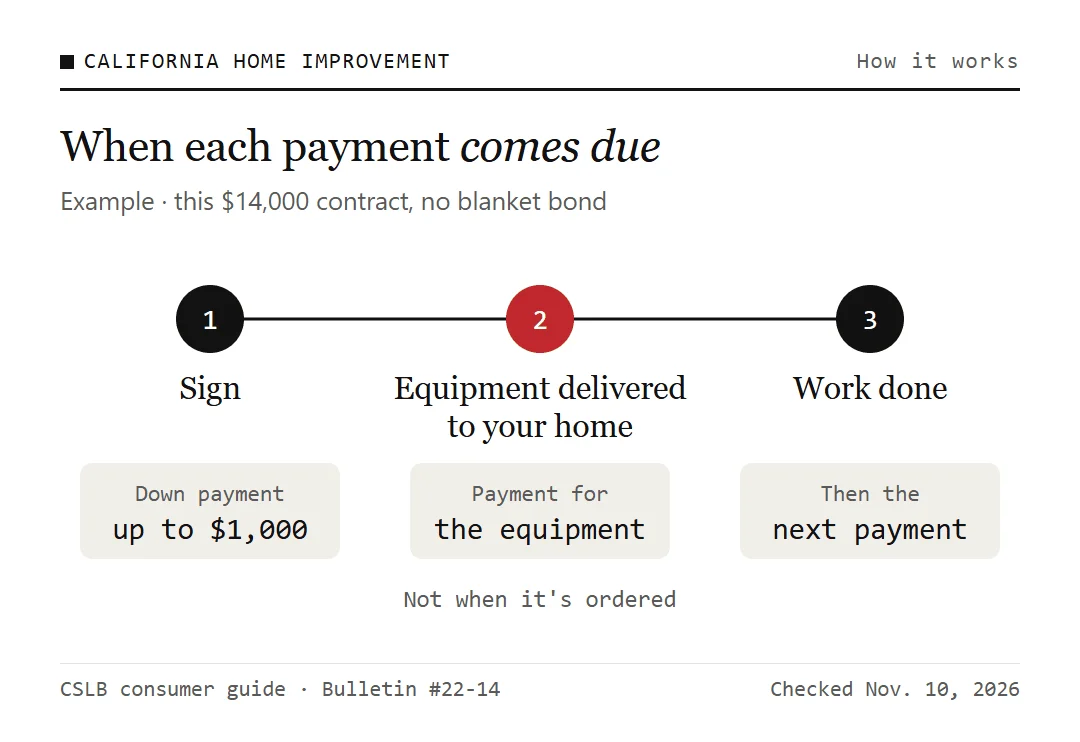
Payments follow the work, not the order form.
One thing switches all of this off. A contractor with a CSLB-approved blanket performance and payment bond is exempt from the down payment cap and the progress payment rules. CSLB calls them “a handful of licensees,” and the bond is noted on the contractor’s license detail page, which CSLB’s license check pulls up. “We’re bonded” can also mean the ordinary contractor license bond, and that one doesn’t lift the cap.
If the contract isn’t signed yet, or it is and you want to keep the job, then the fix goes on paper. Once a contract is signed, any change to it has to be in writing, as a change order that becomes part of the contract.
“Can you rewrite the Down Payment line to the legal amount for this contract price, and list the equipment in the Schedule of Progress Payments as a payment due when it’s delivered to the house? I’d like that as a written change order.”
After signingWhen the Check Has Already Cleared
If you signed at home, then you have 3 business days after signing to cancel, or 5 if you’re 65 or older on a contract signed since Jan. 1, 2021. The cancellation goes to the contractor in writing, with no penalty, and the contractor has to return anything you paid within 10 days of receiving it. Any materials already applied to the contract go back to the contractor.
The same $14,000 contract signed by a 64-year-old and by a 67-year-old has two different last days. Neither gets the window if the contract was negotiated at the contractor’s place of business.
Past the window, the CSLB publications and statute sections behind this post don’t include a rule that makes a contractor return only the part over the limit. What they do give you is the rest of the schedule. Later payments can’t get ahead of the work and the delivered materials, and you can ask for full, unconditional lien releases and hold further payments until you have them.
Taking more than the legal down payment is a misdemeanor and grounds for discipline by the board, and CSLB takes complaints from homeowners. None of this covers a service and repair call of $750 or less that you asked for, where nothing is paid until the work is done, or a job of $500 or less, and other states set their own rules.
Keep the page with the Down Payment box, a copy of any notice you send, and the date it went out.